


Why Trump Is Focusing on Greenland. In early 2026, Greenland — a vast, icy island in the Arctic that is part of the Kingdom of Denmark — has unexpectedly become one of the most talked‑about geopolitical flashpoints on the planet.
At the center of the discussion is U.S. President Donald Trump’s renewed focus on Greenland and his assertions that the United States needs greater access to or control over the territory.
This strategy has sparked intense debate, strong pushback from Denmark and Greenlandic leaders, and broader concerns among Europe and NATO partners.
This article explains why Trump is focusing on Greenland, exploring his strategic goals, the geopolitical logic behind his actions, the pushback he’s faced, and what it all means for global security in 2026.
A Return to a Controversial Proposal
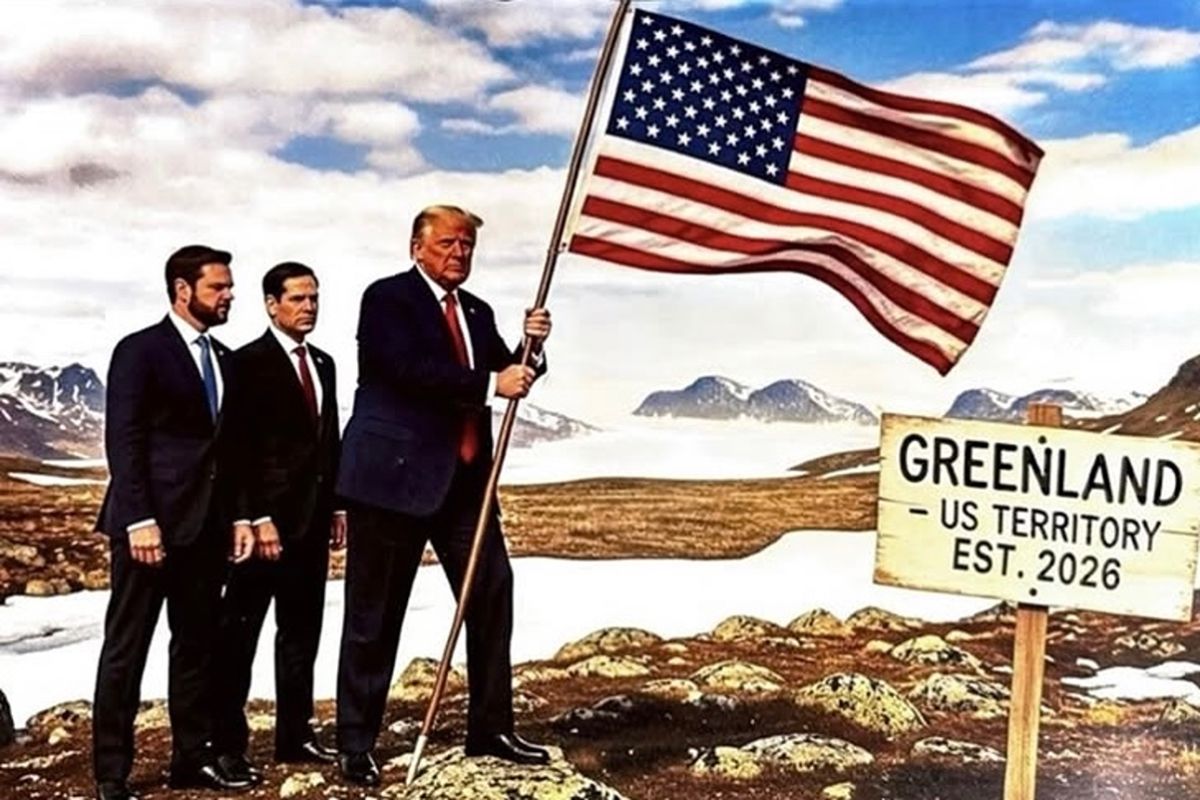
Trump’s interest in Greenland isn’t entirely new. During his first presidential term, he caused a political stir by suggesting the United States should buy Greenland from Denmark — a proposal that was rejected at the time. In 2026, he has revived this idea in a more ambitious form, suggesting negotiations for acquisition or at least deeper U.S. involvement in the Arctic region.
At the World Economic Forum in Davos, Trump described Greenland as essential to U.S. national and international security, framing it as a necessity rather than a luxury. He insisted he did not intend to use force to take control, instead pushing for negotiations under the banner of defense and strategic interests.
1. Strategic Military Importance: Guarding the Arctic Gateway
A core component of Trump’s focus on Greenland is security — particularly Arctic security.
Greenland occupies a crucial position between North America and Europe, placing it directly along potential air and missile routes. Historically, it has been home to U.S. military installations like Pituffik Air Base (formerly Thule Air Base), which plays a key role in early warning systems and defense monitoring against long‑range threats. Trump and his supporters argue that full control or direct influence over Greenland would enhance America’s ability to defend the homeland and deter adversaries in a high‑stakes military environment.
As Trump himself said at Davos, the U.S. needs to be able to “defend” Greenland because in strategic terms, “you need ownership to defend it.”
This thinking is rooted in the belief that NATO partners alone cannot reliably secure all of the Arctic region and that U.S. capability should be central to collective defense. While many military analysts point out that the U.S. already cooperates closely with Denmark and NATO in Greenland, the Trump administration argues that formal control would eliminate ambiguity in defense planning.
2. Great‑Power Competition: Countering Russia and China
Another major driver is intensifying great‑power competition — particularly with Russia and China, both of which have growing interests in the Arctic.
Russia has long maintained a significant military presence across the Arctic, including radar sites, airfields, and naval forces. China, meanwhile, has declared itself a “near‑Arctic state” and has deepened involvement in Arctic infrastructure, scientific research, and commercial activity, though experts characterize its presence as commercial rather than military.
Trump’s national security team sees Greenland as a forward position to counter both powers. By strengthening American influence in the region — whether through military access, defense infrastructure, or strategic partnerships — Trump aims to limit the ability of Russia and China to gain leverage in a region that is becoming easier to navigate due to climate change.
U.S. officials often highlight that as Arctic ice recedes, new sea lanes and resource opportunities open up, making control of territory like Greenland more significant than ever before.
3. Arctic Resources and Future Economic Potential
While Trump has publicly denied that Greenland’s natural resources are the chief motivation behind his plans — stating that the desire is based on security rather than resource extraction — many analysts believe resource potential is part of the calculus.
Greenland is believed to contain significant deposits of rare earth elements, uranium, copper, and other critical minerals that are essential for high‑tech industries, defense technologies, and clean energy — especially as global demand grows. Extracting these resources today is difficult due to harsh Arctic conditions, deep ice cover, and environmental concerns, but future technological and geopolitical shifts might make such resources more viable and valuable.
Even if not the primary driver, resource potential adds an economic dimension to the strategic argument. Many experts see Trump’s security arguments as intertwined with a desire to position the U.S. advantageously for future access to Arctic mineral wealth — even if extraction isn’t immediate.
4. NATO, Transatlantic Relations, and Military Partnerships
Trump’s Greenland focus is closely linked to his broader critique of NATO burden‑sharing and alliance dynamics.
At Davos, he criticized European NATO members for allegedly not contributing enough to collective defense, suggesting that U.S. leadership justified a more substantial role in key strategic areas like the Arctic.
Trump and NATO Secretary General Mark Rutte later announced what they described as a “framework” for future cooperation involving Greenland and broader Arctic security — potentially stabilizing the situation and avoiding tariffs that Trump had threatened against European allies over the dispute.
However, officials in Greenland and Denmark have expressed skepticism and confusion over these negotiations, with Greenland’s prime minister noting that the local government was not fully informed about what had been discussed.
In essence, Trump’s approach ties Greenland to transatlantic military strategy, using alliance talks as leverage to gain deeper U.S. involvement in Arctic defense — a stance that has met with mixed support among European leaders.
5. Nationalism, Legacy, and Political Messaging
Analysts also see a domestic political dimension to Trump’s Greenland strategy. Some commentators argue that Trump’s fixation on Greenland serves symbolic and legacy‑oriented goals: pursuing historic, bold moves that dominate headlines and reinforce his image as a leader willing to challenge norms and expand U.S. influence.
Greenland — a vast territory larger than many U.S. states but sparsely populated — becomes a dramatic symbol of territorial ambition and strategic daring. Even if practical outcomes are limited, the rhetoric generates global attention and reinforces the narrative of Trump as a bold, decisive leader reshaping American foreign policy.
This messaging component is part of Trump’s broader America First approach — framing U.S. foreign policy around clear national interests and assertive action rather than multilateral restraint.
6. Balancing Public Messaging and Reality: Minerals, Sovereignty, and Local Opposition
It’s important to separate what Trump has publicly stated from what some analysts believe underlies the strategy.
Trump insists he is not primarily motivated by Greenland’s mineral wealth, emphasizing that climate and ice conditions make extraction impractical at present and that his focus is security.
However, critics point out that Greenland’s size, location, and long‑term economic potential undoubtedly factor into strategic considerations. Rare earth elements and other critical minerals could become highly valuable in future tech and defense supply chains, especially if new shipping routes open as Arctic ice melts.
Another key reality is that Greenlandic and Danish leaders firmly reject any transfer of sovereignty to the United States. Greenland’s premier and Denmark’s government have repeatedly stated that the territory is not for sale and that any decisions about its future must respect local governance and international law.
This resistance shapes the context in which Trump’s ideas must operate, reinforcing that acquisition isn’t merely a transaction but a complex diplomatic and legal challenge.
7. The Broader Geopolitical Picture: Arctic Competition and Security Architecture
Trump’s Greenland strategy also fits into a much broader geopolitical competition in the Arctic region.
As climate change makes the Arctic increasingly navigable, countries such as Russia, China, Canada, and the United States are all seeking to strengthen their footholds. Military assets, naval patrols, resource claims, and scientific missions all have strategic implications.
The United States already participates in Arctic defense frameworks with NATO and has existing bases and agreements in Greenland. Trump’s proposals seek to expand that role by formalizing access, enhancing military planning, and tying Greenland more closely to U.S. defense networks.
Europe, for its part, is responding with its own strategies, including plans to invest in Arctic security measures and strengthen partnerships to ensure stability without undermining sovereignty or alliance cohesion.
Understanding Trump’s Statements and Their Impact
Trump’s public statements about Greenland — ranging from claims that the U.S. must “have” the territory to assurances of peaceful negotiations — reflect both strategic intentions and political messaging. Analysts note that his rhetoric can oscillate between bold ambition and diplomatic recalibration, especially when confronted with strong pushback from allies.
For example, facing objections from Denmark, the EU, and NATO partners, Trump stepped back from threats of tariffs and instead highlighted a cooperation framework aimed at Arctic security — signaling a willingness to adjust tactics while keeping the strategic goal in view.
What Comes Next?
As of early 2026, the Greenland issue remains unresolved and evolving. Trump’s focus has underscored the strategic importance of the Arctic, forcing allies and rivals alike to assess their roles in the region and refine their policies accordingly.
Possible next steps include:
- Continued NATO and Arctic security negotiations, which may solidify a cooperative framework without transferring sovereignty.
- Expanded U.S. military infrastructure and defense planning in the Arctic.
- Long‑term geopolitical adjustments involving Russia, China, and European players as they respond to American initiatives.
Whatever the outcome, the Greenland focus highlights how strategic geography, security interests, and global competition intersect in a region that was once peripheral but is now central to 21st‑century geopolitics.
Conclusion: A Mix of Security, Influence, and Symbolism
President Trump’s focus on Greenland in 2026 is rooted in a mix of security concerns, great‑power competition, geopolitical strategy, and political messaging.
While Trump emphasizes national and alliance security — particularly against perceived threats from Russia and China — analysts see deeper strategic currents involving Arctic influence, resource potential, alliance dynamics, and U.S. leadership positioning. The combination of these goals explains why a sparsely populated, ice‑covered island has suddenly become one of the most discussed geopolitical issues of the year.
Amid all the rhetoric and debate, one reality remains clear: the future of Greenland — and its role in Arctic security — will be shaped not just by presidential strategy but by international law, local sovereignty, and a complex interplay of global interests.
More Stories
Business News: The Surprising Trend Shaking Up Markets Now
Market Insights Unveiled: Navigating Trends Before They Trend
Future-Proofing Business: Innovation and Adaptation in a Rapidly Changing Economy