


GTC 2026 Investor Guide. On March 16, 2026, the tech world will once again converge on San Jose for NVIDIA GTC 2026.
For investors, this isn’t just a developer conference; it is the annual unveiling of the roadmap that dictates billions of dollars in global capital expenditure.
The primary narrative of 2026 is the strategic transition from the Blackwell architecture, which fueled the record-shattering $68 billion revenue of Q4 FY2026, to the next-generation Rubin platform.
This guide breaks down what investors need to know about the shift, the technology, and the financial “moat” NVIDIA is building for the rest of the decade.
1. The Context: A $215 Billion Foundation
Before diving into the future, we must look at the present. NVIDIA’s recently released Q4 2026 earnings showed a company operating at an unprecedented scale.
- Q4 Revenue: $68.1 billion (73% year-over-year growth).
- Data Center Revenue: $62.3 billion, driven by the massive ramp of Blackwell Ultra and the GB200 NVL72 systems.
- The Outlook: NVIDIA has guided Q1 FY2027 revenue to $78 billion, signaling that the “AI Factory” buildout by hyperscalers (Microsoft, Meta, Google, AWS) is accelerating, not slowing down.
2. From Blackwell to Rubin: The “Tick-Tock” Cadence
NVIDIA has moved to an annual release cycle, a grueling pace for competitors but a goldmine for investors. In 2026, the market is shifting from “training” large models to “agentic” and “physical” AI, which requires more memory and lower latency.
The Blackwell Legacy (2024–2025)
Blackwell (B100/B200) was the first “dual-die” GPU, breaking the physical limits of single-chip manufacturing. It successfully lowered the cost of LLM (Large Language Model) training by an order of magnitude. In early 2026, Blackwell remains the “workhorse” of the industry, but its successors are already sampling.
The Rubin Revolution (2H 2026)
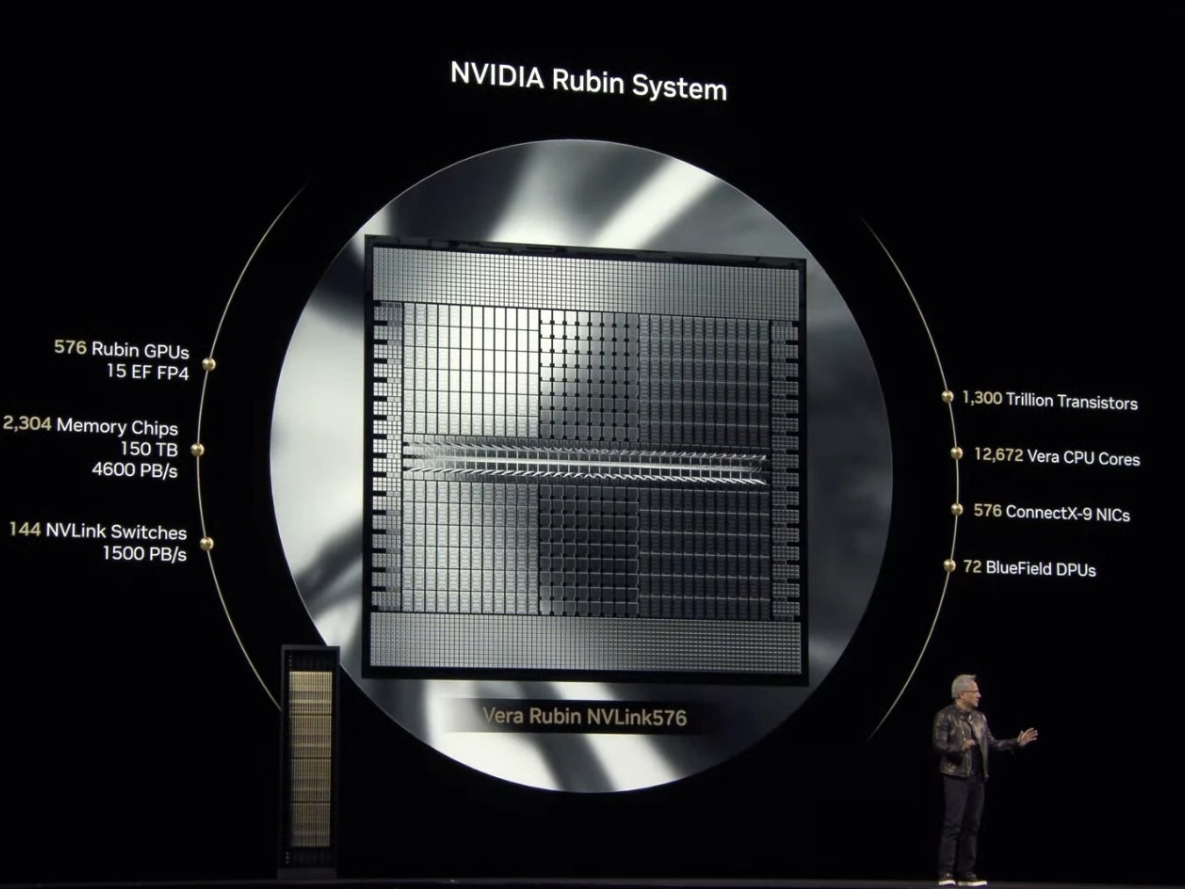
Named after astronomer Vera Rubin, the Rubin (R100) architecture is a “Six-Chip” platform designed for the era of Agentic AI. It isn’t just a GPU; it is a holistic supercomputing stack.
- Process Node: Shifting from TSMC’s 4NP to the cutting-edge 3nm (N3) process.
- Transistor Count: Growing to roughly 336 billion transistors (vs. Blackwell’s 208 billion).
- Memory Leadership: Rubin will be the first platform to fully utilize HBM4 memory, offering up to 288GB of capacity per GPU and a staggering 22 TB/s of bandwidth.

3. The “Vera” Factor: Eliminating the Bottleneck
A major highlight for GTC 2026 is the Vera CPU. For years, NVIDIA GPUs were often paired with Intel or AMD CPUs, which could sometimes bottleneck data movement.
- Custom Olympus Cores: The Vera CPU features 88 custom-designed cores optimized for high-speed data movement and agentic reasoning.
- Total Integration: By pairing the Vera CPU with the Rubin GPU via NVLink 6, NVIDIA offers a 1.8 TB/s interconnect. This is nearly 15 times faster than standard PCIe 6.0 connections used by competitors, effectively “locking in” the entire server rack for NVIDIA.
4. Why Rubin Matters for the Bottom Line
Investors should focus on two words: Inference Efficiency. In 2026, the world is moving from training models to using them (inference). NVIDIA claims the Rubin platform will deliver a 10x reduction in inference token cost compared to Blackwell.
- Margin Preservation: Even as competitors like AMD (with the MI455X) and custom “in-house” silicon from Amazon/Google gain ground, NVIDIA’s “extreme co-design” (making the chips, the networking, and the software work as one) allows them to maintain 75% gross margins.
- Pre-Integrated Racks: Reports suggest NVIDIA is shifting toward selling fully assembled L10 compute trays. This reduces the work for hardware partners but increases NVIDIA’s share of the total hardware spend.
5. What to Watch for at GTC 2026
During Jensen Huang’s keynote on March 16, look for these specific “alpha” signals:
- Rubin Sampling Updates: Confirmation that Vera Rubin samples have reached Tier-1 customers (Microsoft, CoreWeave) on schedule for H2 2026 volume shipments.
- “Physical AI” Partnerships: New deals with automotive (Mercedes-Benz) and robotics firms using the DRIVE Thor and Isaac platforms.
- Networking Revenue: Networking (InfiniBand and Spectrum-X Ethernet) is now an $11 billion business. Any update on the Spectrum-6 Ethernet Switch will be a key indicator for NVIDIA’s growth beyond GPUs.
- The “Feynman” Tease: Look for the first official mention of the 2028 architecture, currently codenamed Feynman, which targets the next wave of robotic and “embodied” AI.
Conclusion: The Infrastructure of an Industrial Revolution
As we head into GTC 2026, the transition from Blackwell to Rubin represents more than just a spec bump. It is a fundamental shift toward making AI as cheap and ubiquitous as electricity. For the investor, NVIDIA is no longer a semiconductor play; it is the landlord of the global AI factory. The Blackwell ramp provided the floor; Rubin is designed to provide the ceiling for the next decade of growth.
More Stories
Is Your Money Working Smarter Than You Are
Are You Leaving Money on the Table: Smart Personal Finance
Future of Finance 2026: What’s About to Change?