


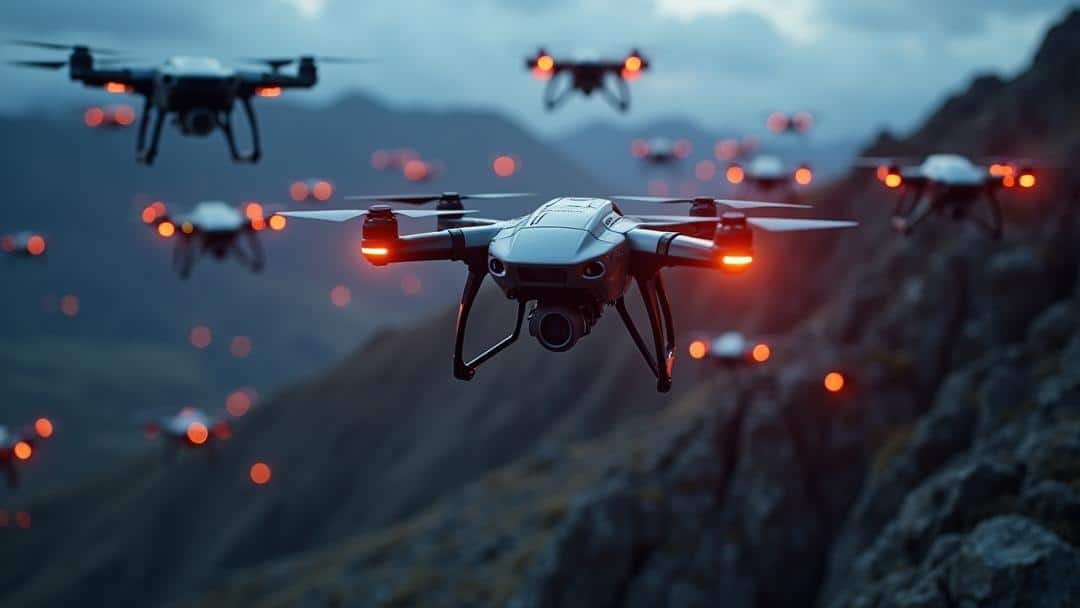
Aviation’s New Rules. The horizon of the 2026 aviation landscape isn’t being redefined by massive jetliners, but by coordinated “clouds” of autonomous technology.
Drone Swarms—groups of unmanned aerial vehicles (UAVs) that communicate with each other to complete complex tasks—have officially transitioned from military classifieds to the commercial mainstream.
However, with great coordination comes great regulation. As of January 1, 2026, new international frameworks from the FAA (USA), EASA (Europe), and the CAA (UK) have gone into effect to manage these high-density operations.
This guide breaks down the essential new rules for operating drone swarms in 2026.
1. Remote ID: The Digital License Plate
In 2026, the era of “anonymous” flying is over. Remote Identification (Remote ID) is now mandatory for nearly all drone operations. For swarms, this requirement is particularly rigorous.
- The “Swarm Broadcast” Rule: In a swarm, every individual unit must broadcast its own unique telemetry, but the software must also transmit a “Lead ID.” This identifies the entire swarm as a single operational entity to Air Traffic Control (ATC).
- The 100g Threshold: In the UK and EU, the registration threshold has been lowered. Any drone over 100g with a camera must now be registered and broadcast Remote ID data.
- Real-Time Tracking: Authorities can now see the operator’s location, the drone’s altitude, and its emergency status (like low battery) in near-real-time.
2. BVLOS and the End of Case-by-Case Waivers
Previously, flying Beyond Visual Line of Sight (BVLOS)—essential for large-scale swarms—required months of paperwork for a single waiver. In 2026, the FAA’s Part 108 and EASA’s U-Space regulations have shifted to “Performance-Based Approvals.”
- Operating Permits: Organizations can now obtain a “blanket” permit for BVLOS swarm missions if they use Type-Certified hardware that meets standardized safety benchmarks.
- The “Category” System: Airspace is now divided by population density. Swarms are generally permitted in Category 1-3 (rural to suburban) under standard permits, while Category 5 (dense urban zones) requires a more rigorous “Operating Certificate.”
3. New Roles: Operations Supervisors vs. Pilots
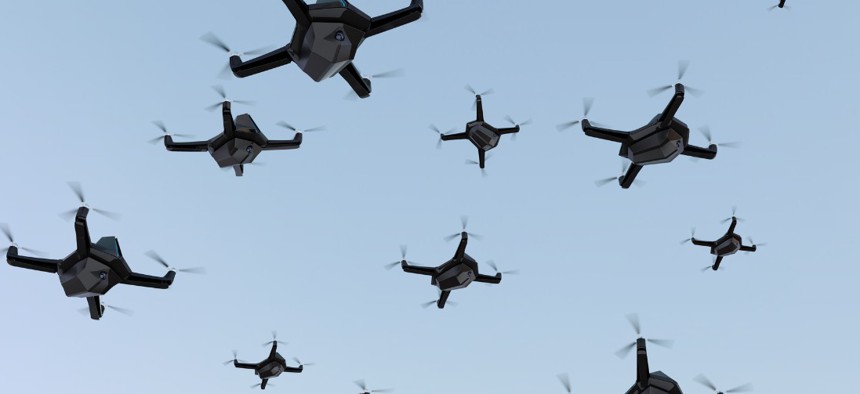
The definition of a “pilot” has fundamentally changed in 2026. Because one person cannot manually fly 50 drones at once, the law has introduced two new certified roles:
- Operations Supervisor: This person holds final authority over the entire swarm mission. They focus on mission-level safety and compliance.
- Flight Coordinator: Rather than using joysticks, these professionals monitor the autonomous systems. They intervene only as a “last resort” using pre-programmed commands (e.g., “Return to Home” or “Land Immediately”).
Note: Manual control is no longer a requirement for swarm flight coordinators, as 2026 regulations prioritize AI-driven deconfliction over human reflexes.
4. The “Hardware Hangover”: Security & Sourcing
2026 has introduced strict “Geopolitical Compliance” for drone hardware. Due to the American Drone Security Act and similar EU directives, the use of foreign-made drones (specifically from China) is now restricted for federal and critical infrastructure projects.
- The “Blue List”: Only drones on approved “Blue Lists” or those meeting the “Buy American Standard” (60%+ domestic components) can be used for government-funded swarm operations.
- Cybersecurity Mandates: Swarms must now use encrypted C2 (Command and Control) links. Regulators now treat a drone swarm as a data network, requiring the same level of protection as a corporate server to prevent “swarm-jacking.”
5. Commercial Use Cases: Advertising vs. Utility
The rules for what a swarm can do have been clarified this year:
- The Advertising Ban: The UK CAA and other bodies have prohibited “UAS Swarm Advertising.” This means using a swarm to create a giant QR code or a corporate logo in the sky is generally illegal under civil aviation acts.
- Entertainment vs. Marketing: While a swarm depicting a “fireworks” display of a dragon or a star is allowed for entertainment, using that same swarm to display a product name is a contravention of 2026 advertising laws.
- Utility Excellence: Swarms are now the standard for Agricultural Spraying and Industrial Inspection, where a group of drones can map a 500-acre farm or a 10-mile pipeline in a fraction of the time a single unit would take.
6. U-Space and Automated Traffic Management
By mid-2026, U-Space (the European drone-traffic management system) is fully operational in major cities.
- ADSPs: Automated Data Service Providers now manage drone traffic digitally. Before a swarm takes off, the operator must submit a digital flight plan to the ADSP, which automatically deconflicts the path with other drones and manned aircraft.
- Mandatory Integration: Any swarm operating in a “U-Space Geographic Zone” must be integrated with these automated systems to ensure they don’t drift into the path of an emergency medical helicopter or a commercial jet.
Conclusion: The Sky is Now a Software System
In 2026, aviation has officially moved from a “one-pilot, one-plane” philosophy to a “one-supervisor, many-nodes” reality. The new rules regarding Remote ID, BVLOS permits, and hardware security ensure that while the skies are more crowded, they are also more organized. For businesses, the message is clear: the opportunity for scale is massive, but the “paperwork” has gone digital, and compliance is the only way to stay airborne.
More Stories
Business News: The Surprising Trend Shaking Up Markets Now
Market Insights Unveiled: Navigating Trends Before They Trend
Future-Proofing Business: Innovation and Adaptation in a Rapidly Changing Economy